
FAITH
Belief vs knowing

FAITH
As a youngling, immediately after watching action movies at the local video show shack, I would feel like and embody Rambo, Chuck Norris, or whoever was starred as the invincible fighter. Nothing seemed too be big or strong enough to bring me down. When involved in a brawl afterwards; the Van Damme in me would come out and demolish whoever the opponent was. It might have resulted in a few bruises or a broken nose but largely I emerged victorious.
Most people often personify the character in a film, songs, or book by live action role playing (larping). This involves feeling and acting out the way the character would have done going so far as to render the character’s world over the surroundings. Actors often do this when researching the role they play through method acting. They take on their character’s name, mannerisms, and environment in their normal life as they prepare to act it out on scene. Heath Ledger, Marlon Brando, Robert De Niro, Meryl Streep, and Daniel Day-Lewis produce realistic and convincing performances by utilizing the technique.
The act of having faith is no different from method acting or larping. When you want a certain thing for example cash, passing exams, or even healing you have to feel and act like you have got it in order to get it. Atheists may be tempted to stop reading at this point but I welcome their criticism at the end of the article.
First of all reality has multi-faceted aspects to it. It can be viewed as a simulation, game, energy farm, multi-dimensional realm, celestial timepiece, or a dojo where we come to sharpen ourselves. Non-spiritual folk see it as existence on a physical plane. All these perspectives can be backed with evidence and personally I consider it as all the various definitions. The only way to be fully immersed is reality is through mindfulness.
We operate in two states of cognizance, consciousness and the subconscious. The conscious self is when one does things intentionally and in full awareness. It includes doing things one enjoys, new things, or when in danger. One can easily perceive the dangers and opportunities surrounding him because they have engaged the full faculties of the brain. Unconscious cognition takes about 80% of our day while doing repeat tasks, replaying old scenarios, and, on the other hand, refers to mental processes that occur outside of our conscious awareness. These processes can include automatic or habitual behaviors, as well as intuitive or emotional responses that we may not fully understand or be able to explain. Unconscious cognition can also involve information that is stored in our long-term memory, but may not be immediately accessible to our conscious mind.
Both states play important roles in our cognitive processes. Unconscious cognition can help us make quick decisions, process information more efficiently, and perform tasks without conscious effort or attention. Conscious cognition, on the other hand, allows us to engage in more deliberate and intentional thinking, problem-solving, and decision-making.
It enhances one’s capacity to be still and calm in order to flesh out the circumstance surrounding the individual. This is a recommendation by various holy texts venerated by various religions. In the Bible there are around 12 verses instructing believers to be still in the face of various adversities. Buddhism was founded on the act of meditation under a tree. Jesus meditated in the desert before launching His ministry. Hinduism, Buddhism, Islam, Taoism, Shintoism, Bahaism, Jainism, Sikhism among others prescribe some form of meditation practice among its adherents. Moreover meditation has been widely practiced by communities for thousands of years.
The manifestation gospel is also insistent on using breathing techniques to calm one’s self. Governments have also invested in the meditation stonks way before it was mainstream. Documents being declassified indicate that the CIA and KGB have studied meditation practices and used them on soldiers, especially those involved in astral warfare. The practice was found to enhance the mental acuity of the Jedi during astral travels. Snipers are trained to make use of calmness during combat; controlled breathing, single-mindedness, and sheer will.
Yogis and other meditation masters may make it seem like it is a walk in the park; it is not. Firstly, your mind, body, and surrounding bio field will be the main sources of distraction. Beginners may get a rush after a series of successful meditation trip. However, experienced meditators warn against excessive excitement from such an achievement. This is due to it going against the basic tenets of meditation; calmness. Once meditation becomes a regular undertaking, one is able to have better better focused on their activities and intentions thereby making them more likely to attain their goal.
Additionally, writing and uttering words of affirmation are also key in manifesting what one wants. Magick is directing and controlling energy using natural forces. Words transform into frequencies and vibrations. Numerology, words, and magic have been intertwined for centuries, and all three play an important role in the ancient practice of divination. Numerology is the study of numbers and the significance they hold in a person's life. This significance is often linked to the letters of the person's name, as each letter has a corresponding number. According to numerology, a person's birth date and name can be used to determine their life path number, which is said to reveal important information about their personality and life purpose. Numerologists may use this information to make predictions about a person's future or to gain insight into their current situation.
Mystics have also asserted that the human body spells out the name YHWH. The body has four "pillars" that correspond to the four letters of YHWH, with the head (yod) representing the topmost pillar, the two arms (heh) representing the two middle pillars, and the torso (vav) representing the bottom pillar
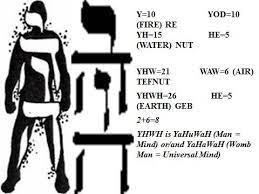
.
The idea is often linked to the notion that humans are created in the image of God and that the body itself is a manifestation of divine consciousness or energy. In some spiritual traditions, the body is seen as a temple or vessel for the divine, and the recognition of the body's inherent sacredness is an important aspect of spiritual practice. What is more, four nucleotide bases that make up the DNA molecule, adenine (A), thymine (T), cytosine (C), and guanine (G), can be interpreted as the letters YHWH, which is one of the names of God in the Abrahamic religions.
The Bible alludes to this in Psalm 82:6, which reads, "I have said, Ye are gods; and all of you are children of the most High” collaborates this. Furthermore, as Yahshuah was preparing his disciples for his departure he told them that whosoever believes in him would the same and even greater works than him since they come from the Father.
Words hold immense power in magic, as they can be used to evoke certain energies, cast spells, and influence the world around us. In numerology, the power of words is expressed through the numerical values of the letters that make up a name, date, or phrase. The combination of these numbers can provide insight into a person's personality, destiny, and even predict the future.
The magical use of numbers and words is not limited to numerology, however. In many ancient cultures, numbers were believed to have mystical properties, and were used in spells, incantations, and rituals. For example, the number three was often associated with the goddesses of the moon, fertility, and life, while the number seven was considered sacred and related to the goddess of wisdom and knowledge.
Similarly, words and names were also believed to hold magical power. In many cultures, names were chosen carefully, often with the help of diviners or other spiritual leaders, to ensure that the person was given a name with the right energies and vibrations to support them throughout their life. These names could be used in spells, incantations, and rituals, to evoke specific energies, or to protect the person from harm.
Numerology, words, and magic are all interconnected, and each plays an important role in the ancient practice of divination. By understanding the significance of numbers and words, and how they can be used to evoke specific energies and influences, we can tap into their magical power to help guide our lives and shape our destinies. Whether used for divination, protection, or to cast spells, the power of numerology, words, and magic can be a valuable tool for those seeking to understand the mysteries of the universe and their place within it.
Finally, feeling is an essential component of manifestation, as it helps to create the emotional energy needed to bring your desires into reality. Manifestation is the process of bringing your thoughts and desires into physical form, and emotions play a crucial role in this process. Esther Hicks, Rhonda Byrne, Wayne Dyer, Neville Goddard, have expounded this phenomenon further in best sellers, lectures and talk shows.
When you feel strong emotions, such as joy, excitement, and gratitude, you are sending positive vibrations into the universe. This energy helps to attract and align with similar energies, bringing your desires closer to you. On the other hand, negative emotions, such as fear, doubt, and worry, send negative vibrations and can block or delay manifestation.
Feeling also helps to build belief and conviction in what you are manifesting. The more you feel the emotions associated with having already achieved your goal, the more likely it is to become a reality. This is why visualization and affirmations, which help you to focus on and feel the emotions of your desires, are powerful manifestation tools.
In addition to creating the emotional energy needed for manifestation, feeling also helps to create a state of receptivity and openness. When you are in a state of positive emotion, you are more likely to be open to opportunities, see solutions to problems, and receive guidance from the universe. The concepts of placebo and nocebo are related to the power of belief and expectation in influencing human experiences and outcomes, including in the realm of manifesting.
A placebo is a substance or treatment that has no known therapeutic effect, but which may still produce a positive effect on a person's symptoms or condition due to their belief in its efficacy. This is commonly known as the "placebo effect". Placebos can be used in clinical trials to assess the effectiveness of new treatments, but they also have relevance in manifesting. For example, a person may use a placebo, such as a sugar pill, to help them believe that they are taking action towards achieving their goals or improving their wellbeing, and this belief may help them to manifest their desired outcome.
A nocebo, on the other hand, is a negative expectation or belief that can lead to negative outcomes or adverse effects. This can occur even when there is no physiological reason for such effects to occur. For example, a person who believes that a certain food will make them sick may experience nausea or other symptoms even if the food is harmless. In manifesting, a nocebo effect could occur if a person holds negative beliefs or expectations about their ability to achieve their goals or manifest their desires.
In both cases, the power of belief and expectation is key. Believing that something will work, or conversely, that something will not work, can have a real effect on a person's experience and outcomes. Therefore, when using manifesting techniques, it is important to focus on positive beliefs and expectations, and to avoid negative self-talk or limiting beliefs that could contribute to a nocebo effect.
According to Jung, knowing refers to a direct experience of something that is grounded in empirical evidence or observation. In other words, knowing is a form of knowledge that is based on facts and evidence, and it is not subject to doubt or uncertainty.
On the other hand, believing refers to a subjective attitude toward something that may or may not be grounded in fact. Beliefs are often influenced by personal values, cultural norms, and subjective experiences, and they can vary from person to person.
Carl Jung, a Swiss psychoanalyst believed that knowing and believing were both important aspects of human experience, but he emphasized the importance of distinguishing between the two. He argued that confusing belief with knowledge could lead to dogmatism, intolerance, and a lack of critical thinking.
Jung also believed that there were limits to what could be known through empirical evidence, and that certain aspects of human experience, such as spirituality and the unconscious, were best approached through belief and subjective experience.
Overall, Jung's perspective on knowing vs. believing emphasizes the importance of critical thinking, empirical evidence, and the recognition of subjective experience and belief as important aspects of human psychology.
Some modern scientific interpretations can link quantum physics to faith. Experiments suggest that the observer plays an active role in shaping reality through the act of observation. This has led some spiritual practitioners to believe that the power of consciousness and intention.
Another possible connection is the concept of interconnectedness. Quantum physics suggests that everything in the universe is interconnected and part of a larger system. Similarly, many spiritual traditions emphasize the interconnectedness of all beings and the importance of living in harmony with the natural world.
Some spiritual beliefs suggest that there is more to reality than what can be observed through the physical senses. Quantum physics has also led to discoveries that challenge our traditional notions of reality and suggest that there may be underlying structures or dimensions that are not visible to the naked eye. Some spiritual practitioners may view this as evidence of a higher spiritual reality or consciousness beyond the physical world.
In addition to faith, spiritual traditions emphasize the importance of putting in the work and taking concrete actions to achieve spiritual goals. From a Christian perspective, the New Testament states "faith without works is dead" (James 2:26). This passage emphasizes that faith alone is not enough for salvation, but must be accompanied by good works or actions. Similarly, in the Islamic tradition, the concept of "iman" (faith) is often described as a combination of belief and action, with the two being inseparable.
Similarly, in Buddhism, faith is seen as a key component of spiritual practice, but is also viewed as incomplete without the corresponding effort and action required to achieve enlightenment. The Eightfold Path, for example, emphasizes the importance of right action, right speech, and right livelihood as means of achieving spiritual growth and liberation from suffering.
In Hinduism, faith is seen as an essential component of spiritual practice, but is also viewed as incomplete without the corresponding effort and action required to achieve spiritual goals. Karma yoga, for example, emphasizes the importance of selfless action and service to others as means of achieving spiritual growth and union with the divine.
Overall, while there may be differences in emphasis and approach across various spiritual traditions, most emphasize the importance of both faith and action in achieving spiritual growth and enlightenment. Faith provides the motivation and inspiration to pursue spiritual goals, while action provides the means by which those goals can be realized. Here’s a quote from Terence McKenna, ‘Nature loves courage. You make the commitment and nature will respond to that commitment by removing impossible obstacles. Dream the impossible dream and the world will not grind you under, it will lift you up. This is the trick. This is what all these teachers and philosophers who really counted, who really touched the alchemical gold, this is what they understood. This is the shamanic dance in the waterfall. This is how magic is done. By hurling yourself into the abyss and discovering it's a feather bed.”
To summarize, feeling is an essential aspect of manifestation, as it creates the emotional energy needed to bring your desires into reality, helps build belief and conviction, and creates a state of receptivity and openness. Putting in the work is also seen as an act of faith since one is taking steps to achieve one’s goals. By focusing on the emotions associated with your desires and taking action geared to it, you can successfully use the power of manifestation. What are you waiting for; the inner Neo is waiting and you to go forth and gaslight yourself into living the life of your dreams.
A comprehensive study of emotional understanding. Synchronization of one's goal with the emotions.
Good work my brother
Well articulated read on faith vs knowing, meditation, feelings and interconnectedness with ones goals and dreams. Well researched and done. Great work